Followers

Thursday, October 27, 2022

MONASTIR: A diverse and pleasant resort-city


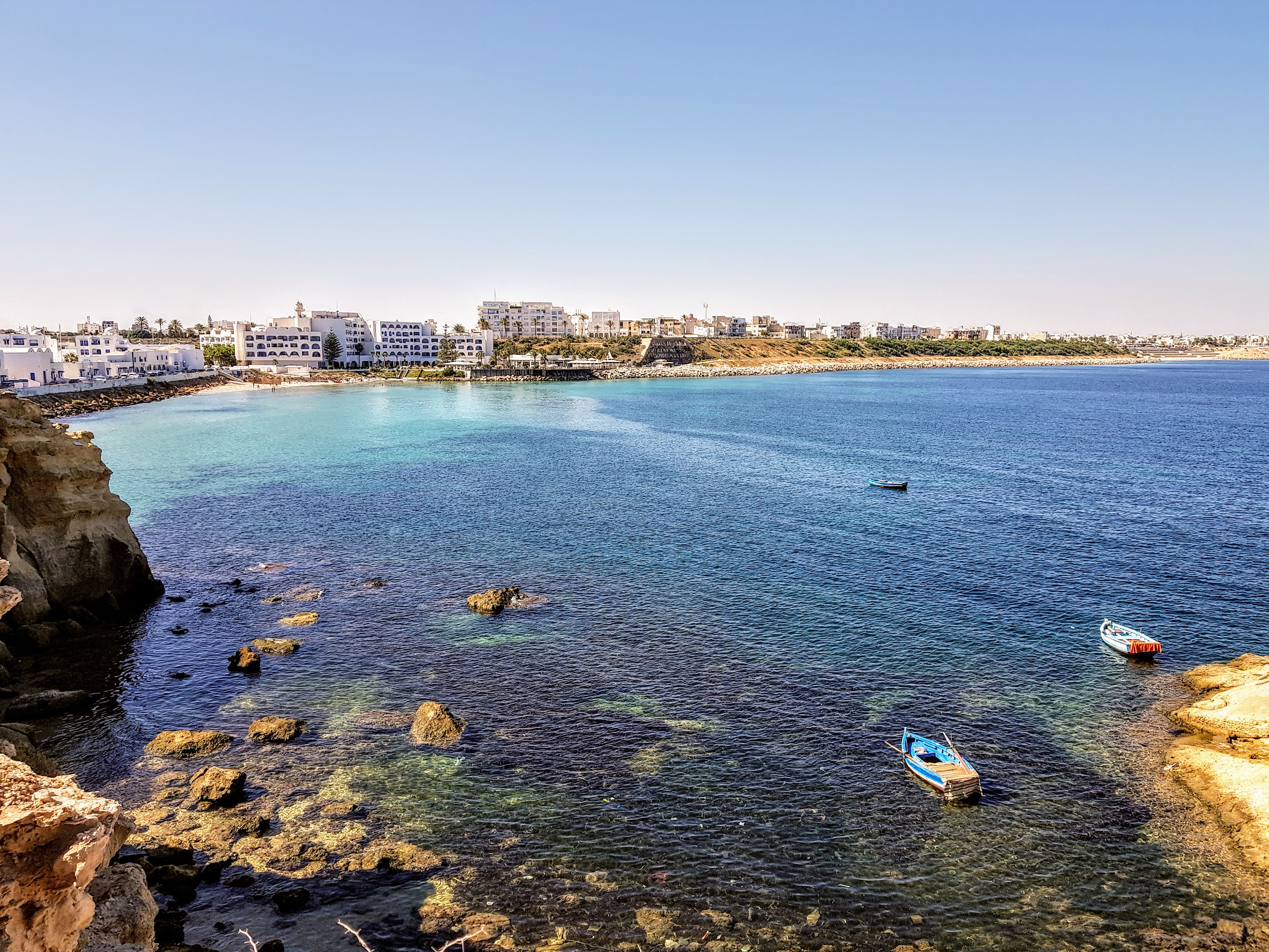
A cove near the Marina

Halfway on the eastern Mediterranean coast of Tunisia, Monastir offers a superb and diverse location, prone to please all.


Monastir, the former Punic-Roman 'Ruspina', has been built on a promontory above the Mediterranean. Although it looks modern in many ways, there is still an old town, called the medina, entirely surrounded by walls. The massive fort, called the Ribat, was built to protect the harbor and the city from pirates or foreign invaders such as the Byzantines. Monastir is also the hometown of Habib Bourguiba (1903-2000), the Father of the Tunisian Republic and its first President. His impressive mausoleum stands near the Ribat, being de facto the second landmark of the town.

The seafront promenade, below the Ribat, is currently undergoing a major renovation. It offers a wonderful seafront with a small sandy beach that makes the pride of the city. The Marina is also nearby and remains a place of stroll and leisure for visitors and city-dwellers.

Located just behind the Great Mosque and its tall minaret, the old town remains a scenic and pleasurable section of Monastir. 

Monastir has an international airport allowing holiday-makers to easily reach the many hotels and resorts on the coast. Consequently, Monastir is an ideal place to combine a vacation with a bit of sightseeing. As a matter of fact, many interesting sites can be visited nearby: Sousse (N), Mahdia (S), El-Djem (S-W), or even Kairouan (E).

C.S.

The Ribat

The old and the new

At the Marina

Downtown main square

The fishing harbor

Promontory view of the town

The central cemetery

The city's public beach

Seaview

The seaside boulevard

At the Corniche drive

The door of a private home

Downtown

A coffeeshop terrace on the Corniche

Evening scene on the central square

Evening view

A mosque at night

Moonlight over a minaret
 
Evening light at the Marina

Panoramic view of Monastir

Sunday, October 23, 2022

Monastir : ce qu’un nom peut parfois révéler

 Voisine de Sousse et située entre Hammamet, au nord, et Sfax, au sud, la Ville de Monastir a une histoire fort intéressante, un peu oblitérée aujourd’hui par sa réputation de station balnéaire.

   La topographie locale nous donne tout d’abord quelques précieuses indications sur le choix du site. 

Fig. 1

Que voit-on en regardant sa position géographique ? Outre le fait que ce soit un lieu central  sur la côte du golfe de Gabès (Fig.1), on remarque qu’il s’agit d’une péninsule, à vrai dire, atypique (Fig.2).  Cette péninsule est tournée à la fois vers le nord (le golfe d’Hammamet), mais elle s’ouvre largement aussi sur la partie orientale de la côte méditerranéenne, ayant même un œil en direction du sud, l’ancien lac Tritonis des Grecs [Τριτωνίδα λίμνην]. Mais ce n’est pas tout ! La partie terrestre occidentale est largement occupée par un vaste lac séparant Monastir du reste du pays ; de telle sorte qu’on est en présence d’une presqu’île. En outre, le long de la partie orientale de la péninsule, il existe deux autres presqu’îles formant chacune une anse. La première se trouve côté nord - celle de la Marina moderne - et la seconde forme un magnifique havre : celui du port de pêche.

En d’autres termes, ce lieu fait donc figure d’un remarquable site naturel défensif. Et évidemment, ce sont les Phéniciens qui ont été les premiers à en exploiter la situation. La topographie des lieux correspond d’ailleurs aux choix habituels phéniciens, tels que l’on les retrouve dans d’autres comptoirs méditerranéens. Le site archéologique de Ruspina [RSPN] a été d’abord phénicien (IVe siècle av. J.-C.), puis punique et enfin romain (146 av. J.-C.).

Y-a-t-il une relation entre l’isolement naturel d’une presqu’île et le nom d’un lieu? Cette question se pose véritablement pour le toponyme de Monastir. Ce mot serait issu du terme grec  monastérion [μοναστήριον], “célibataire” ou “solitaire” pour qualifier l’isolement monastique d’une cellule de moine.

Fig.2

Le terme serait passé ensuite dans la langue arabe, donnant Mestir [المنستير], soit Monastir. Or, comme pour corroborer cette assomption, tournons-nous vers un monument emblématique de l’histoire de Monastir : le “Ribat”. À l’arrivée des conquérants arabes au VIIe  siècle de notre ère, cette partie de l’Ifrqiya a été conquise avant toutes les autres. Kairouan, proche de Sousse et de Monastir, est fondée en 670. La Grande Mosquée fait de Kairouan la première ville sainte du Maghreb et le quatrième lieu saint de l’islam. Or pour protéger cette région du Sahel tunisien des invasions byzantines, il a fallu construire des forteresses le long des côtes. C’est le rôle joué au départ par un “ribat” [رِبَـاط]. Il y en a deux dans cette région : celui de Sousse et celui de Monastir. Celui de Monastir est le plus ancien (796). Un “ribat” est donc une petite forteresse abritant une garnison militaire. La ville marocaine de Rabat doit son nom au “ribat” construit sur une éminence défendant l’embouchure du Bou Regreg. C’est également le cas du Rabat maltais (Ir’rebet). Mais avec le temps, le “ribat” est devenu un gîte pour les voyageurs, puis un lieu de refuge des mystiques, en particulier un lieu d’accueil des premiers courants du soufisme. “Cette particularité assimile le « ribat » à un couvent fortifié de moines  guerriers.”

Il est donc singulier d’appréhender comment la topographie d’un lieu isolé a pu s’associer à un toponyme prolongeant en quelque sorte un concept similaire : celui d’une retraite monastique telle qu’elle apparaît dans l’appellation du lieu. Cette remarque est d’autant plus pertinente qu’en général la toponymie maghrébine a le plus souvent une origine libyque.

Christian Sorand


Intérieur du Ribat de Monastir


Cour intérieure du Ribat de Monastir

Saturday, October 22, 2022

The Old Medina of Hammamet

 Here is a place I have visited on numerous occasions. Yet, I keep going back there whenever I am back to Hammamet! Hard to believe; what is there that makes it such an attractive place?

-This is what I'll try to explain today to acknowledge this feeling of attraction.

First of all, this is due to its location. The old medina is spread within the limits of its own ramparts, partly hidden by the massive structure of the Turkish-Spanish Fort guarding a promontory. One section of the fortifications is built above the sea. Consequently, the medina is limited in size. However, it is a maze of narrow alleys, where losing your sense of orientation is easy.

Then, this place is kept absolutely spotless bearing the emblematic seal of the Tunisian white and blue. But this is still not enough to account for the attractiveness. The medina has indeed its own characteristics and remains a highly architectural trove. There are indeed many cultural wonders there: doors, windows, mosaics, wooden lattices, arches... A local artist has spread the colorful shape of a fish here and there. Plants, flowers, and bushes adorn sometimes the streets and houses. As this is a country for cats, countless numbers of them are there as a substitute for the few locals you may encounter. There are times when visitors are the only people you can meet around! This is a place where the inhabitants live behind the high whitewashed walls. Sometimes, a door left open enables the eye to see the interior, a staircase leading to the terrace, or a view of an inner yard. 

Perhaps, you may be lucky enough to access one of these fabulous open terraces. Then, this is another sublime sight over the roofs, the walls, the cupolas, and the nearby blue Med! Chances are high that it will be on one of these wonderful sunny days!

So, this is why this old medina is so quietly attractive. As a matter of fact, it is probably one of the most beautiful old sections in Tunisia.

Christian Sorand

The fish symbol in one of the alleys

An alley


Inside a building

Interior of a restaurant lounge

The mosque

A street

An archway

Blue Door


White Door

Just a simple place!

White & Blue

An elaborate doorway

The cats

Black & White passageway

A house at night

The fortifications

Sunset over the medina walls on the sea

Friday, October 21, 2022

Return visit to HAMMAMET

Bay of Hammamet

Some places seem to be endowed by a magnet effect. You don't really know why, but they keep attracting you over and over again. Hammamet stigmatizes this type of attraction at least on me!

It is difficult to tell exactly why it is so. It is mainly a feeling of being there, happy to walk around, and revisiting places you have been to on many other occasions. I guess it is a combination of sensations, which are in keeping with your sensibility. Coming from Tunis, very often, the climate is different: often sunnier and slightly milder. Hammamet is facing the East and therefore is fully blessed with the Mediterranean influence. Its wide bay provides a 180º view that offers sunrises as well as sunsets. And sunsets are particularly scenic here. No need to go far: the downtown promenade offers an ideal viewpoint. So much so that visitors, as well as locals, come here in the evening to watch the setting sun! Some more, this area offers benches or a vast area to walk leisurely. The small sandy beach there provides a natural anchorage for the many fishing boats. There are also cafés and restaurants along this promenade. And Hammamet is a place where eating fish is a pleasurable must. That's not all! The old medina is there too. Behind the high walls of the Turkish Fort, the old, traditional city offers a maze of wonderful alleys so clean and so colorful that you get thrilled with the atmosphere.

Of course, Hammamet is also a large, modern city as well as a fashionable seaside resort with many hotels. But it still keeps a specific atmosphere,  particularly if you are there off-season. Yet, this particular blend of urbanity and natural environment might be the essence of what makes Hammamet so special.

Christian Sorand

One of the seaside resorts


On the beach under the sun

An old town section

A private home in an alley

Outside a bookshop

Inside the same bookshop

Typical white & blue Tunisian architecture

Sunset on the seaside promenade

The medina walls 

Hammamet Bay at sunset

The Fort walls at night

One evening on the seafront promenade

Typical Tunisian dinner

The old fishing beach of Hammamet

An evening sky on the bay

Sunset on the Bay of Hammamet