Followers

Tuesday, May 22, 2018

Etosha National Park, Namibia.

Map of Etosha National Park
For over more than a century, the wildlife sanctuary of Etosha has been protected as one of the oldest African National Park.
Located in northwestern Namibia, just south of the Angolan border, this huge reserve is the home of a great many animals, including some endangered species like the black rhinoceros. The park is set around the vast Etosha pan and has a few camps opened to visitors. It must be seen from a vehicle as it is strictly forbidden to get out in the wilderness. At night, the camp lodges are closed by a gate, usually from sunset to sunrise. During the night, each camp has its own lit waterhole, where visitors can see the animals silently and safely protected.
The countryside is made of a vast saline area (the Etosha pan), woodlands, savanna, and grasslands. All of this makes it possible to observe a wide variety of animals: mammals, reptiles, birds, and four of the big five: lion, leopard, elephant, and rhinoceros (but not the buffalo).
An ostrich near the Etosha pan.
As I visited the park, we stayed at two different rest camps: first at Halali Camp, and then at 
The Okaukuejo tower
Okaukuejo Camp, which is both the oldest and the park headquarters. 
Although it is quite rare to be able to see or even approach leopards, we were lucky to spot a mother leopard and its two cubs. The mum did not seem to mind being observed and it gave us the chance to see them interact for quite some time.
As a matter of fact, many animals, when they feel there is no danger, are rather easy-going and even curious to look at you! This was the case with two rhinos, two jackals, and even a group of nosy ground-squirrels.
Among the big birds that can be seen in the park, three are often encountered: the ostrich, the Northern Black Korhaan, and the Kori Bustard.
Indeed, Etosha National Park looks like it is an animal kingdom enabling visitors to watch them in their natural environment.
Christian Sorand

Sunset in the park
Springbok
A Leopard with one of its two cubs.
Ground squirrels
A lone male Elephant
A white Rhinoceros
A Black-backed Jacqual
A Lion (an a lioness lying on the grass)
A group of Blue Widebeests
A group of Guinea-Fowls
An Ostrich
A Kori Bustard
Two Zebras

Portrait of an Impala

Monday, May 21, 2018

The Namib Desert

Map of the Namib Desert area & location
The name 'Namid' originates from the Nama tribe and means a 'vast place'. It also gave the country its name.
At Solitaire.
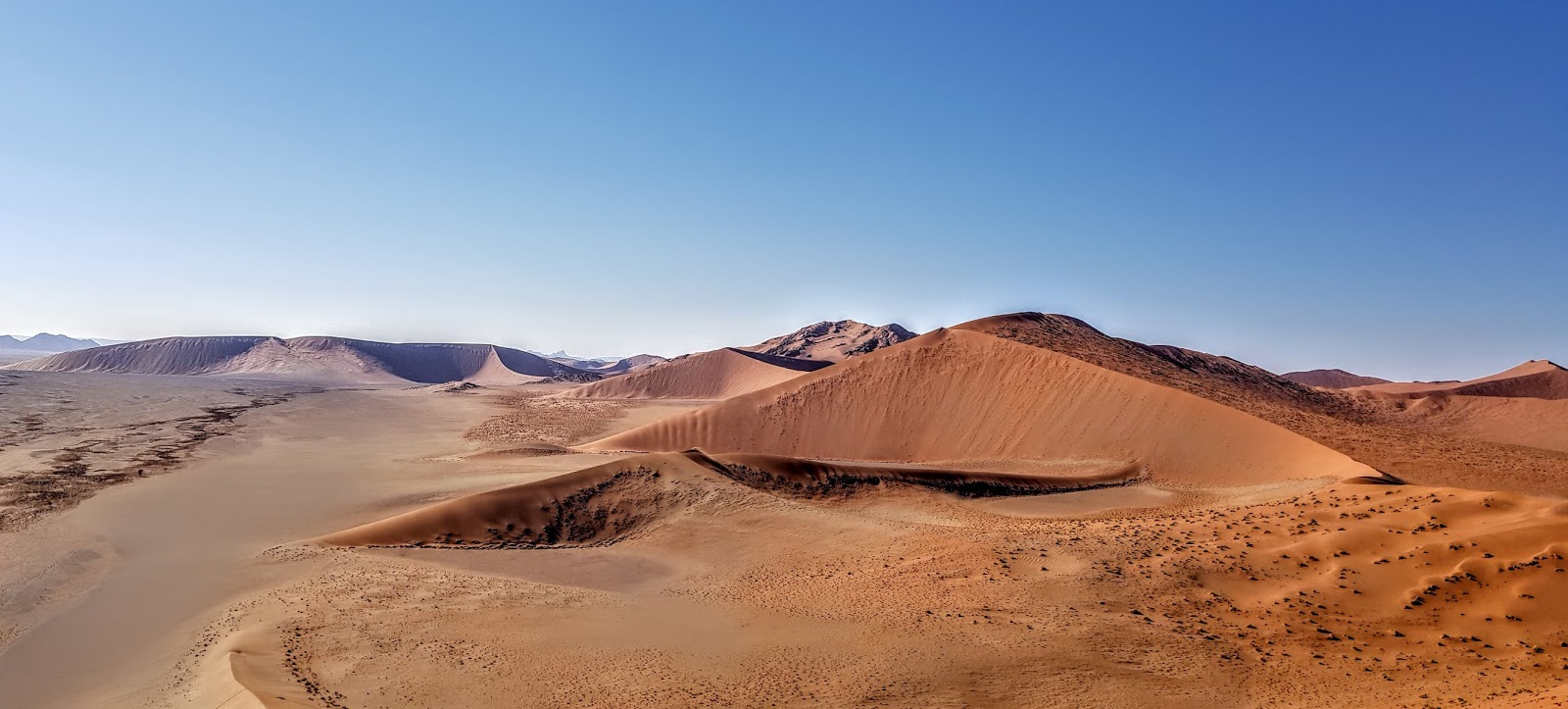
The Namib Desert is thought to be the oldest desert in the world dating back to 55M years. The Tropic of Capricorn crosses the region in the middle. The latitude in the southern hemisphere and the cold Benguela current from the Arctic have created this vast desert along the south Atlantic coast. It stretches for about 2,000km from the south of Angola to South Africa. In Namibia alone, its length is of about 1,500km with a width varying between 120 to 80km. 
A Welwitschia mirabilis.
The cold air from the ocean and the warm air from the desert create morning fogs along the coast. This source of humidity is bringing the water needed to some biological species, endemic to this particular region of the Earth such as the protected Welwitschia mirabilis. However, the interior remains one of the driest areas in the World with the Atacama Desert on the western coast of South America. The landscape varies from area to area. Some of the elusive streams like the Swakop or the Kuiseb Rivers have created canyons in the rocky formations, whereas other flat areas are covered with gravel. But the sand dunes
The Moon Landscape near Swakopmund
are among the highest on the planet, either along the coast in the Walvis Bay/ Swakopmund area or in the Sossusvlei region near the oasis of Sesriem. The latter that belongs to the Namib-Naukluft National Park, is also a UNESCO World Heritage natural site.
The Atlantic coastline is shallow and in the past was responsible for many shipwrecks that have created the Skeleton Coast, north of Swakopmund. The only two real harbors are Walvis Bay, in the middle, and Luderitz, in the south.
This desertic area is also the home of several different species. There are antelopes like oryxes or springboks. But there are also ostriches or the desert elephant, a smaller species of the African elephant. Other animals include the Black-backed jackals, hyenas, meerkats, ground-squirrels, birds, snakes, several species of lizards, or insects like beetles or sand termites.
The red sand dunes of Sossusvlei.
The Namib Desert is a beautiful mineral land. This desert faces the ocean on one side, like the Arabian Desert or the Atacama. It has a great touristic potential, already a source of sightseeing in Namibia.
Christian Sorand

Sossusvlei: Dune 45
At the top of Dune 45
Sossusvlei: A Sea of Sand.
At Dead Vlei.
Sesriem: top of the canyon.
Sesriem: riverbed canyon.
Moon Mountain view.
The Sand Dunes along the Atlantic Coast.
The Kuiseb River mountains.
Kuiseb River Canyon.

Friday, May 18, 2018

The Mineral World of Namibia

Namibia's beauty is not only seen on its geographical surface. It is also deeply encrusted in its soil. Although two of its best-known assets are diamonds and uranium, its earth keeps many gems and crystals such as quartz, agates, tourmalines, and even a gem variety that was once discovered here and called 'pietersite'.
Pietersite " was discovered in Africa in 1962 by Sid Pieters. It is a stone with swirling blue, gold, or red color bands naturally cemented with quartz. Pietersite was revealed by Sid Pieter’s during 1962 while he was looking for farmland in Namibia, Africa. After his finding, he registered his findings in the mineral records of Britain. In fact, his entire discovery wasn’t published since 1964. The material was to be known as “Pietersite”. “[quote]
A chatoyant Pietersite


Here are two places I went to in order to learn more about these African minerals:

1. A diamond factory and display showroom at the Namibian Craft Center of Windhoek.
How to deal with diamonds
About diamonds and the rare tanzanite

An article about the tanzanite

A black diamond necklace
All the shades of the tourmaline
2.The Krystall Galerie in Swakopmund.

This wonderful, contemporary building has a museum, a gem factory, and a jewelry shop, where you can actually buy what is on display.
Huge crystal on display
At the museum
A lit crystal inside the museum
Showroom world-record
Amethyst geode
Citrine geode


Meteorite found in the desert
Another amethyst geode
Black Tourmaline crystals


Schorl (the most common form of Tourmaline)
Azurite
Almandine Garnet


Selenite
Aquamarine
Namibian Tourmaline
Namibian Piertersite
Various crystals

Fluorite


Sulphur
Native Copper

Christian Sorand