|
| Map of walled city |
Chiang Mai is a religious and cultural city in the north of Thailand. It spreads on a valley at the foot of a mountain range towering above. It is an old, historical place, which was the capital of the Lan Na Kingdom for 500 years (from 1296 to 1768) before becoming a province of the Siamese Kingdom. Its name means 'New City' (Chiang, city & Mai, new) because it became the second capital of Lan Na after Chiang Rai (Rai, means old). Chiang Mai was founded in 1296. Today it is Thailand's third largest city with about 1M inhabitants. But it has retained a provincial charm and an exotic architectural style from its Lanna heritage. As it is 700 kilometers north of Bangkok, its climate is usually cooler, particularly during the months of November to February and at night the temperature drops considerably during this period of time. During some colder years, the temperature falls down close to 0º. It has not been classified by UNESCO as of now, but a request has been made to make it a World Heritage Site. Its ancient walled city has the shape of a square that was surrounded by a wall and a large moat. The moat remains in the shape of a canal planted
 |
| On Thapae Road |
with trees on its banks. Part of the city walls remain, mostly on the four corners, which were defended by fortified brick towers. There were also five gates to access the royal city. But Chiang Mai is also a city with many temples: it is said there are 350 temples, some as old as the city itself, founded in the 12th century. Chiang Mai retains a charm of its own and attracts many visitors from Thailand or from all parts of the world. It is a city with a leisurely life pace. Some come here to learn about Thai cuisine; some come here to learn Thai or the art of massage. Spas and massage parlors are found all over town. It is a place to taste the delicious Thai food in its many restaurants or just cool off at bars or by the Ping River that flows through the city. What also makes Chiang Mai attractive is the presence of many hill tribes in its immediate surroundings. Needless to say that shopping for art, curios or traditional hill tribe souvenirs is one of the many pleasures of this great city. As a matter of fact, Chiang Mai is also a well-known center for its hand-painted umbrellas.
 |
| Café courtyard |
 |
| Fruit stall |
Here is a list of Chiang Mai's most interesting landmarks and attractions. They are classified in three different groups: the town area between Thapae Gate & the Ping River, the walled city and finally its immediate surroundings.
Town section between Ping River & Thapae Gate
One of the main attractions in this part of town is the place known as the Night Bazaar. But these days the Night Bazaar is not as interesting as it used to be. Many hotels are in this section. So there are many bars, shops, restaurants, and the inevitable massage parlors, which cater for the tourists.
Walking from here to Thapae Road as far as Thapae Gate can be quite interesting if you decide to use the alleys. But since it is a mini maze, make sure you have a good map and a sense of orientation if you have never been in this area before. It is quite interesting as there are many boutique hotels, guesthouses or hostels here.
Once you are on Thapae Road, make sure to visit a first temple called Wat Buppharam.
Wat Buppharam (วัดบุปผาราม)[1497]- This is a very interesting and beautiful temple made of several parts.
The Dhamma hall (Ho Monthian Tham, 1996) is a two-storey building adorned with mythological animals. The word 'dhamma' or 'dharma' refers to cosmic law and order.
A white chedi (or stupa) of mixed Mon and Burmese style guarded by four Singh (Burmese-style lions).
A small Lanna-style viharn (sermon hall) built in teakwood and dating from the 16th century
A larger viharn which dates back to 18th century.
 |
| Dhamma Hall |
 |
| Mythological animal |
Thapae Gate- As you reach the walled city, you can see the former city moats that now look like a canal and parts of the brick walls that surrounded the ancient city of Chiang Mai.
The main road behind the gate is called Rachadamnoen Rd.
The walled city
Like the Chinese or Khmer cities, Chiang Mai old city was designed in the shape of a square.
There are so many temples everywhere that it is hard to know which ones to choose. But as you walk
 |
| Lanna Architecture |
on Rachadamnoen Rd., you reach a garden with a wonderful traditional house on the left side:
Lanna Architecture Center- This is a beautiful example of a Lanna house that has now become a research center and an exhibition hall dedicated to the Lanna culture. The garden has also a nice little café to rest and cool off.
At the street corner there, turn on the left into Phra Pok Klao Road to see two of the most interesting temples.
Wat Panthao- The original temple was built in the 14th century and is thought
 |
| Wat Panthao |
to have been a royal throne hall. The present viharn dates back to 1876 and is entirely made of teakwood panels. It has a three-tiered roof and a superb facade.
 |
| Inside Wat Panthao |
 |
| Standing Buddha |
Wat Chedi Luang ( วัดเจดีย์หลวง)- 'Temple of the big stupa'[14th century] is a grandiose place not
 |
| Map of Wat Chedi Luang |
to be missed.
The main viharn [built in 1928] is particularly impressive and holds a big standing Buddha from the 14th century.
The city pillar or Lak Mueang ('Spirit of the City') is kept in the cross-shaped building on the left side. The interior has a rarely designed mural (but it is only accessible to men visitors).
The massive brick chedi in the back is rather typical of Lanna style. It is built on a square base 44m wide and is 60m in height. There are four monumental staircases guarded by mythical nagas (serpent-like mythical animals). There are also stone elephants midway on each side. It was built in 1391.The top of the chedi was destroyed by an earthquake in 1545. It housed the great Emerald Buddha before it was moved to Vientiane, Laos and now in Bangkok.
There are other smaller viharns in the back some having wax figures of past holy monks.
 |
| City Pillar |
 |
| Main Chedi |
 |
| Roof pillar carving |
 |
| Chedi staircase |
 |
| Reclining Buddha |
When you walk back to the intersection, turn left into Rachadamnoen Road and continue straight until a T-junction, where there is another grand temple/monastery.
Wat Phra Singh ( วัดพระสิงห์วรมหาวิหาร)- 'Temple of the Lion Buddha' [14th c]. This temple-monastery was built in 1345. It is a place of major importance in the city life. It is made of several buildings:
 |
| Map of Wat Phra Singh |
The main assembly hall, Viharn Luang (luang is a title referring to a king), was rebuilt in 1925.The red & white interior is impressive and houses a seated Buddha (Phra Chao Thong Tip) that dates back to 1477.
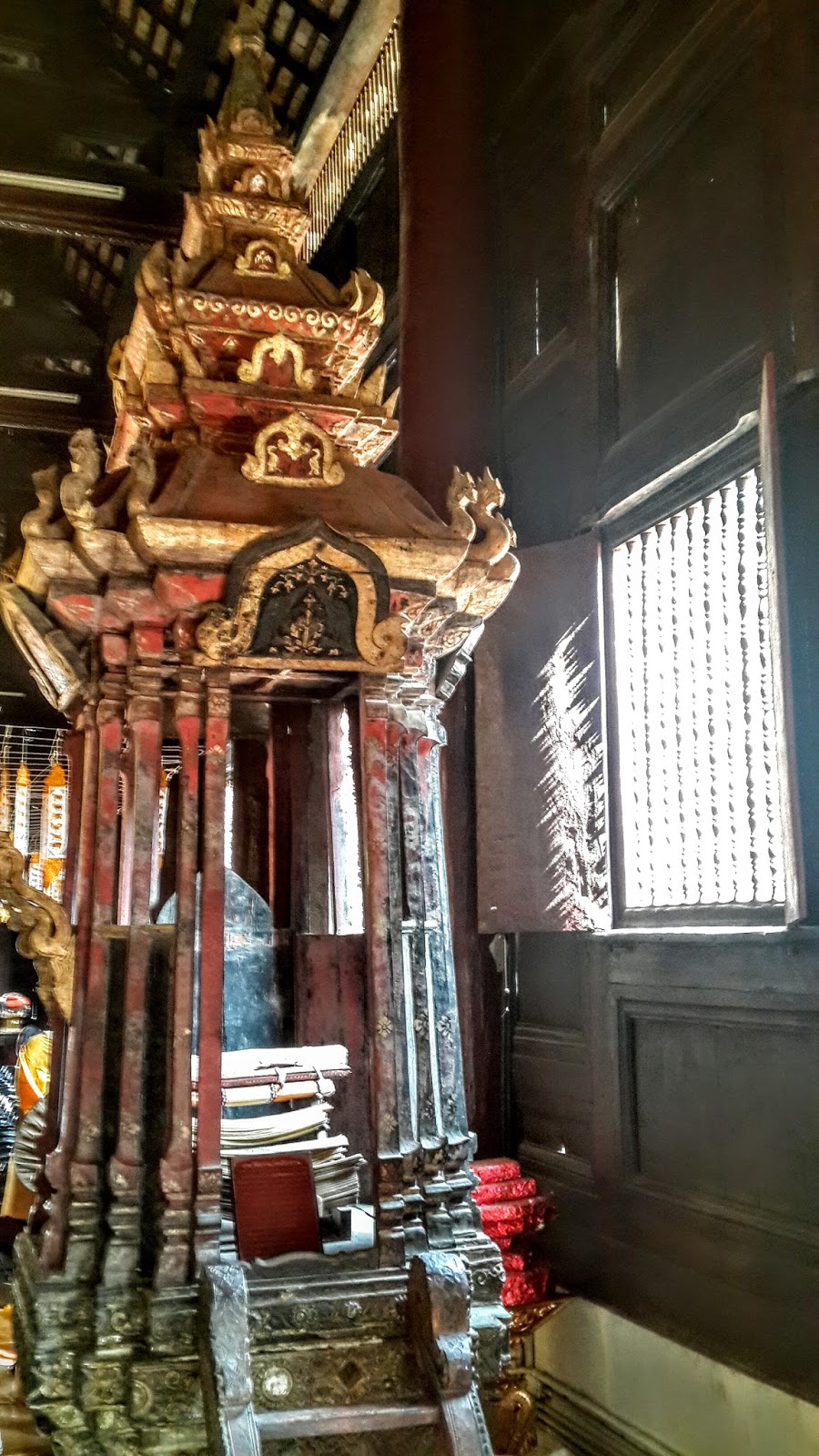
The small elevated building on to the right of the assembly hall is a monastic library (from 1477). It has a white stone base to protect the library from floodings. There are several bas-reliefs with thewadas (Buddhist spirits). The staircase leading to the red wooden library is made of two protecting Nagas.
The smaller assembly hall, Viharn Lai Kham (Gilded Hall) is from 1345 but was restored in the 19th century. It is a good example of Lanna architecture. It houses the 14th century's Lion Buddha (Phra Singh), which is said to have been brought from India via Ceylon, Nakhon Si Thammarat (in the south) and Ayutthaya before being here. The murals are particularly beautiful.
The largest chedi dates from 1345.
The ubosot (Ordination Hall) was built in 1806.
 |
| Wat Phra Singh main assembly hall |
 |
| Library |
 |
| Main viharn interior |
 |
| Viharn Lai Kham |
 |
| Pavilion of the Reclining Buddha |
 |
| The Reclining Buddha |
 |
| Open sala (Pavilion) |
Wat Phra Singh is at one end of the walled city. So, you must go back to Rachadamnoen Road until you reach the intersection with Prapokkloa Road and make a left turn to the square situated in the middle of the walled city with a sculpture that has become Chiang Mai's landmark.
Three Kings Monument- One of the three kings is the founder of Chiang Mai, King Menrai with the King of Sukhothai and Payao.
But on the street to the left, there is an ancient, gorgeous temple, that not many people know about:
Wat Inthakhin- [13th c]- As it is located in the center of the walled city, it used to house the city
 |
| Wat Inthakhin |
pillar, a symbol of the city foundation. It is very ornate and made of dark wood.
 |
| Interior of Wat Inthakhin |
Back to the square on Prapokkloa Road, continue to your left past a school ground and turn right in the soi next to the Thai Airways building.
Wat Chiang Man (วัดเชียงมั่น) [A.D.1297]- This is the oldest temple as it was built in 1297 by King
 |
| Wat Chiang Man |
Mangrai.
Chedi Chang Lom (the 'Elephant Chedi') has 15 elephants emerging from the square base of the chedi. [#1]
The main Wihan renovated in the 1920s. [#2]
A smaller new Wihan that houses two important statues of the Buddha: the Phra Sae Thang Thamani or 'Crystal Buddha', a 10cm tall statue made of quartz crystal; and the Phra Sila, a stele with a standing Buddha, which is thought to come from Ceylon from either the 8th or 10th century. [#3]
A Ubosot, that was built in the 19th century. [#8]
 |
| The Elephant Chedi |
A Temple Library (Ho Trai) made of wood.
A Lotus Pond.
 |
| Pond Pavilion |
 |
| Wat Chiang Man temple |
 |
| Wat Chiang Man main wihan |
Sunday night street market- If ever you happen to be in town on a Sunday, do not miss going to the night street market. It starts from Thapae Gate all the way up on Rachadamnoen Road and even in the street of Wat Chedi Luang. This is a typical Asian night market, where local or hill tribe vendors sell their products or craftsmanship.
--> SundayNight street market
 |
| Night market scene |
A photographic night visit of the walled city monuments:
 |
| A street temple |
 |
| Wat Chedi Luang |
 |
| Wat Luang Chedi at full moon |
 |
| Wat Chedi Luang main assembly hall |
 |
The City Pillar
|
 |
| Wat Panthao gate |
 |
| Lit façade of Wat Phantao |
Outside of Chiang Mai
 |
| Map of national park |
While in Chiang Mai, it is nice to explore its immediate surroundings made of mountains, waterfalls, lakes, rainforest, and a lovely countryside, not to mention some of its hill tribe communities. There are many things to do. Here are a few options.
 |
| Doi Suthep view on Chiang Mai |
Wat Phra That Doi Suthep (วัดพระธาตุดอยสุเทพ) [A.D. 1383]- This is a must see visit as this is the
 |
| Map of Wat Doi Suthep |
holiest Buddhist shrine in northern Thailand. It is at about 15km away above the city at an altitude of 1,000m above sea-level. So the air is cooler there and there is a great viewpoint over Chiang Mai from the temple. Doi Suthep is in fact the name of the mountain, which is also a national park (Doi, means 'mountain' in Thai). It is covered with a rainforest and some hill tribes live there. One group often performs dances at the temple. Once you arrive at the site, you have the choice to either take the incline to the temple or decide to walk up the 309 stairs guarded by two giant Nagas. The visit of the frescoed cloister on the upper terrace with all its shrines, bells, Buddha statues, golden umbrellas and shiny chedi, will remain a highlight of your trip. Some more, it is fascinating to observe the rituals of prayers made by dozens of worshippers, who come here to pray and make offerings. Make sure to see the statue and the shrine of the white elephant, which made the legend behind Wat Doi Suthep.
 |
| Staircase to temple |
 |
| Upper terrace |
 |
| View on the mountain rainforest |
Mae Sa Elephant Camp- Elephants play an important role in Thailand's cultural and religious life.
 |
| Mahout on his elephant |
They are highly revered and admired for their strength, intelligence and playfullness. This camp was founded in 1976 and offers a good opportunity to see and approach Asian elephants and their mahouts. The park is set in a natural environment on a hillside by a river. You can also ride an elephant, go and feed them, watch them bathing or attend an amazing show and watch how they can actually paint with their trunks!
→ Maesa elephant camp
 |
| Elephant feeding |
 |
| Elephants bathing |
 |
| Elephant show |
 |
| Painting made by an elephant |
Bai Orchid-Butterfly Farm- In the same area, you can stop at this farm in order to see some colorful varieties of orchids and a nice little butterfly cage, where you are surrounded by many xotic butterfly species.
 |
| Butterfly park |
 |
| Orchid farm |
Tiger Kingdom- This is another nearby attraction. If you really want to approach a real tiger (at your own risk), this is the place to go. It is rather amazing to be able to get a chance to be so near to tigers known as being extremely dangerous animals.
→ Tiger Kingdom
 |
| Tiger with tamer |
Long-necked Karen village- Like in many other places in northern Thailand, there are may hill tribes living in the mountains: the Karen, Lahu, Palong, Hmong, Kayaw or Akha. In the same area as the Tiger Kingdom, there is a village, where it is possible to see a few long-necked Karen. It is a rather touristic attraction, but there aren't many places, where you may see them. They also sell natural products and handicraft.
There are many more things to see in or out of Chiang Mai. The above selection only describes some of the most important attractions that ought to be seen on a trip to the area.
Christian Sorand
--> Weekend in Chiang Mai (Google+ slideshow)